Español
 Francés
 Русский
 Indonesia
 العربية
 Português
 Deutsch
 ไทย
ไทย
 Pilipino


"Hao" product - Three-dimensional Composite Drainage Network
"Hao" product - Three-dimensional Composite Drainage Network



Challenges in the Application of Conventional Drainage Networks
1. Poor corrosion resistance
The conventional drainage network has poor resistance to acids and alkalis, and is prone to hydrolysis. When used in leachate drainage systems such as tailings ponds, red mud storage areas, and hazardous waste landfill sites, it is susceptible to corrosion by acids and alkalis and may fail.
2. Susceptible to clogging of pore structure
The conventional drainage network is relatively loose and has low tensile strength. After landfilling, fine powder particles of the fill material invade the pores and the core of the drainage network, causing the drainage channels to become clogged.
3. Poor compressive strength of the core
The mesh size of the conventional drainage network is large, and the structure of the core is unstable, resulting in poor compressive strength. When subjected to the heavy pressure of the fill material, it is prone to deformation, causing the drainage channels to become smaller or closed.
Product Core Advantages
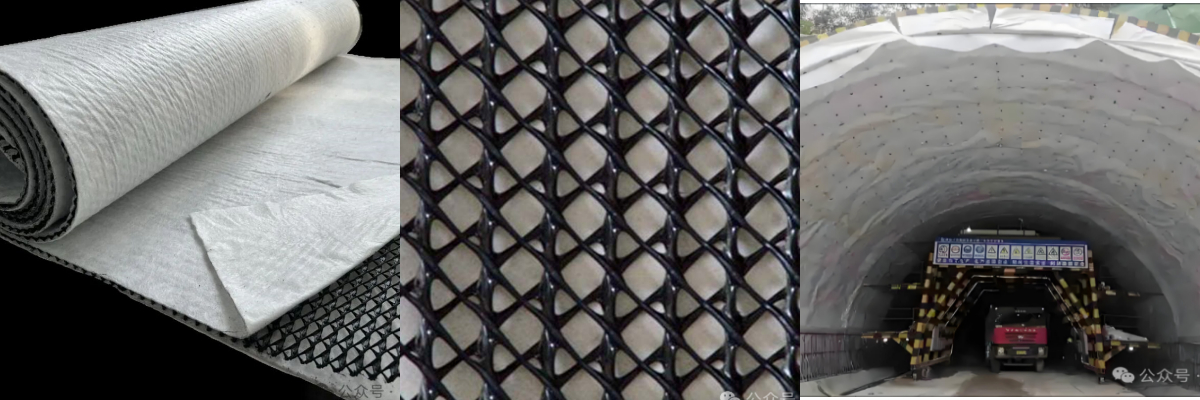
1. Composite fabric with multi-stage filtration mechanism for preventing blockage: The geotextile has high modulus, high tensile strength and anti-blockage properties. The surface pore size is ≤ 0.15 mm, which can intercept sediment while maintaining a water permeability rate of ≥ 5.0×10⁻² m2/s.
2. High compressive resistance with a three-dimensional rib structure of the drainage mesh core, with a compressive strength of ≥ 830 kPa (ASTM D6364) and a deformation rate of < 10%. The water permeability retention rate is > 80% for 100 hours.
3. Fully chemically resistant: After being soaked in 10% sulfuric acid/NaOH for 30 days, the tensile strength retention rate is > 90% (ASTM D7238). Applicable environment: pH 2 - 12.
Application fields
1.Civil Engineering and Infrastructure Construction - Railway Subgrade Drainage:
In soft soil or frozen soil areas, the drainage network uses anti-clogging structures to prevent fine-grained soil from blocking, maintaining drainage efficiency over the long term and avoiding road base settlement caused by water accumulation. Its chemical corrosion resistance can withstand de-icing agents and underground salt erosion, thereby extending the lifespan of the road.
2. Tunnel Engineering:
Tunnel water infiltration often contains sand and other impurities. Traditional drainage pipes are prone to clogging. The multi-layer gradient filtration design of the anti-clogging drainage net can intercept impurities, and at the same time, it releases water pressure through structural elasticity, and the core of the net has high compressive strength to adapt to the complex load conditions of the tunnel.
3. Discharge of leachate from solid waste landfill in environmental protection projects:
The leachate contains high concentrations of organic matter and acidic substances, and ordinary drainage materials are prone to corrosion and failure. The anti-clogging drainage net is made of acid and alkali-resistant materials to resist chemical erosion, and the anti-clogging structure prevents sludge from adhering, ensuring that the leachate collection system can operate stably for a long time.
4. Soil Pollution Barrier Project:
Drainage nets are embedded in the vertical anti-seepage walls to quickly discharge polluted groundwater and prevent the spread of pollutants. Flood control and water conservancy projects such as sea walls and river embankments:
Long-term exposure to saltwater or sediment can cause corrosion or blockage of traditional drainage materials. The anti-acid and alkali and salt fog resistance of the anti-blocking drainage nets can adapt to harsh environments, reducing the frequency of replacement costs.
5. Drainage of the reservoir dam body:
The interior of the earth-rock dam needs to be continuously drained to reduce pore water pressure. The anti-siltation design can prevent fine-grained soil from entering the drainage layer, reducing the construction cost of the backfill layer, and simultaneously lowering the risk of dam failure.
6. Anti-seepage and drainage measures for petrochemical storage areas in the industrial and energy sectors:
The leaked oil or chemicals are highly corrosive. The chemical inert materials used for the drainage network can withstand the erosion of oil, acids, and alkalis. Combined with the drainage system, it can quickly collect the leaked liquid, preventing environmental pollution and reducing the cost of accident handling.
7. Drainage of mine tailings reservoirs:
The tailings slurry particles are extremely fine and prone to clogging the drainage facilities. The non-woven fabric composite layer of the anti-siltation drainage net can perform fine filtration. At the same time, its high water conductivity accelerates the solidification of tailings, reduces the risk of dam collapse, and saves the cost of reservoir capacity expansion.
 Company overview and certificates.pdf