Español
 Francés
 Русский
 Indonesia
 العربية
 Português
 Deutsch
 ไทย
ไทย
 Pilipino


Haoyang Introduces Protective Film Technology to Improve Geomembrane Welding Quality in Harsh Environments
In large-scale environmental and mining projects, the performance of a geomembrane liner depends not only on the material itself, but also on the quality of installation—particularly the welding process. In challenging environments such as deserts, mining tailings facilities, and landfill sites, maintaining consistent geomembrane welding quality has long been a practical difficulty.
Haoyang Environmental Co., Ltd. has recently introduced an improved geomembrane solution designed to address a persistent issue in field installation: contamination at the welding interface.
The Hidden Risk in Geomembrane Welding: Surface Contamination
In theory, achieving high-quality HDPE geomembrane welding requires proper temperature, pressure, and speed control. In practice, however, the condition of the geomembrane surface plays an equally critical role.
Field experience shows that welding performance is highly dependent on surface cleanliness. Even with skilled technicians and advanced welding equipment, contamination such as dust, moisture, or fine particles can significantly reduce seam integrity.
In harsh environments—particularly in desert regions, mining sites, and landfill projects—maintaining a clean geomembrane surface is extremely difficult:
High wind and dust levels can quickly cover exposed geomembrane surfaces after installation
Fine particles and sand accumulate in the overlap area before welding begins
Temperature fluctuations between day and night can cause condensation, introducing invisible moisture
Humidity and dew formation further compromise welding conditions
Under these conditions, even minor contamination can lead to common defects such as:
Weak or incomplete welds
Inclusion of particles within the seam
Air bubbles or voids
Failure in pressure testing
These issues directly affect the long-term performance of geomembrane liner systems, especially in applications where containment reliability is critical.
Limitations of Traditional On-Site Cleaning Methods
The conventional approach to addressing contamination is relatively simple: wiping or blowing the surface before welding. However, in real-world construction environments, these methods often provide inconsistent results.
Cleaning effectiveness depends heavily on manual execution, environmental conditions, and time constraints. In many cases, the geomembrane surface becomes contaminated again within minutes due to wind or dust.
As a result, welding quality can become unpredictable, increasing the risk of leakage in landfill geomembrane systems, mining tailings ponds, and water containment projects.
A Practical Solution: Peelable Protective Film at the Welding Zone
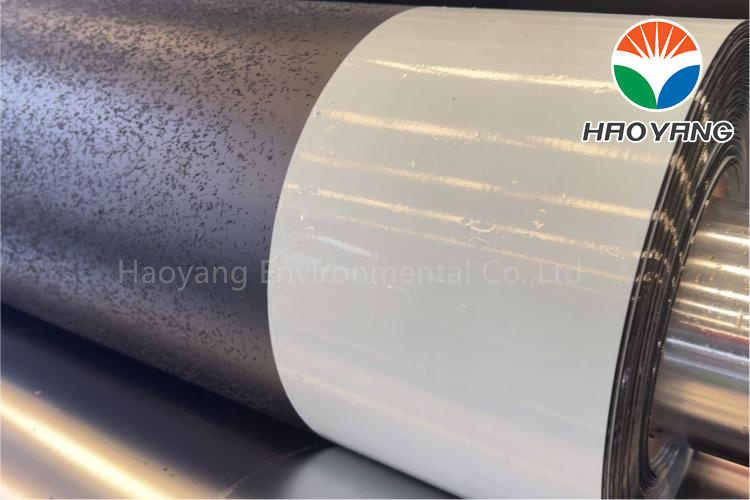
To address this issue, Haoyang Environmental has developed a modified geomembrane structure incorporating a peelable protective film in the overlap welding area.
The concept is straightforward, but its impact on installation quality is significant.
Instead of leaving the welding zone exposed after geomembrane installation, the overlap area is covered with a protective layer that remains in place until the moment of welding.
Installation Process Comparison
After Installation
Conventional geomembrane: Surface is fully exposed to dust, sand, and environmental contamination
Haoyang geomembrane: Welding area remains sealed and protected under a peelable film
Before Welding
Conventional: Surface must be manually cleaned, with results depending on field conditions
Haoyang: Protective film is removed immediately before welding, revealing a clean, uncontaminated surface
During Welding
Conventional: Residual dust or moisture may remain, increasing the risk of weak welds
Haoyang: Welding is performed on a clean surface, improving bonding strength and seam reliability
After Welding
Conventional: Overlap edges remain exposed, with potential for secondary contamination
Haoyang: Additional structural protection reduces exposure and enhances sealing performance
Improving Reliability in Harsh Project Conditions
This design is particularly valuable in projects where environmental conditions cannot be easily controlled, including:
Mining tailings storage facilities
Heap leach pads
Municipal landfill liner systems
Desert water reservoirs
Industrial containment projects
By ensuring that the geomembrane welding interface remains clean until the moment of welding, the solution helps improve seam consistency and reduces dependence on manual cleaning processes.
For contractors and project owners, this translates into:
More stable welding quality
Reduced rework and inspection failures
Improved long-term anti-seepage performance
Greater confidence in project durability
Supporting High-Standard Geomembrane Applications
As environmental standards continue to tighten worldwide, the quality requirements for geomembrane liner installation are becoming more stringent. Projects involving hazardous materials, wastewater containment, or mining operations demand higher levels of reliability and traceability.
Innovations that improve installation quality—rather than just material properties—are becoming increasingly important.
Haoyang's peelable film solution reflects a shift toward application-oriented product design, where materials are engineered not only for performance but also for real-world construction conditions.
Looking Ahead: Practical Innovation in Geosynthetics
The global geosynthetics industry is evolving beyond traditional material supply toward integrated solutions that address both product performance and installation challenges.
In this context, small but practical innovations—such as protecting the geomembrane welding zone—can deliver significant value in large-scale engineering projects.
By focusing on real field problems and improving construction reliability, Haoyang Environmental continues to support more efficient and dependable geomembrane applications in demanding environments worldwide.